

Introduction to Iron Oxides
Iron is one of the metals with the greatest chemical versatility. Its ability to exist in multiple oxidation states (+2 and +3 primarily) gives rise to a family of oxides with very different properties. The most industrially relevant are ferrous oxide (FeO), ferric oxide (Fe2O3) and magnetite (Fe3O4), which can be considered a combination of both.
Understanding the differences between ferrous oxide and ferric oxide is fundamental to correctly selecting the material in pigmentation, water treatment, desulphurisation and catalysis applications.
What is Ferrous Oxide? Formula and Properties
Formula: FeO
IUPAC name: Iron(II) oxide
Iron oxidation state: +2 (ferrous)
Colour: Black to black-greenish
Molar mass: 71.85 g/mol
Density: 5.7-5.9 g/cm3
Water solubility: Insoluble
Crystal structure: Cubic rock salt type (NaCl)
FeO is the least stable iron oxide under normal atmospheric conditions. At room temperature and in the presence of oxygen, it tends to spontaneously oxidise to Fe2O3 or Fe3O4. It forms mainly at high temperatures and in reducing atmospheres, such as in blast furnaces.
What is Ferric Oxide? Formula and Properties
Formula: Fe2O3
IUPAC name: Iron(III) oxide
Iron oxidation state: +3 (ferric)
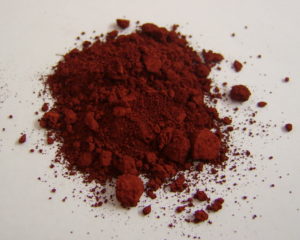
Colour: Red to brownish-red (haematite)
Molar mass: 159.69 g/mol
Density: 5.24 g/cm3 (haematite)
Water solubility: Insoluble
Crystal structure: Rhombohedral (α-Fe2O3 haematite) / Cubic (γ-Fe2O3 maghemite)
Fe2O3 is the most stable and abundant form of iron oxide in nature, constituting the mineral haematite. It is the main cause of the characteristic red-brown colour of oxidised soils and rocks.
Comparison Table: Ferrous Oxide vs Ferric Oxide
| Characteristic | Ferrous Oxide (FeO) | Ferric Oxide (Fe2O3) |
|---|---|---|
| Chemical formula | FeO | Fe2O3 |
| Fe oxidation state | +2 | +3 |
| Colour | Black / black-greenish | Red / brownish-red |
| Air stability | Low (oxidises to Fe2O3) | High (stable form) |
| Density | 5.7-5.9 g/cm3 | 5.24 g/cm3 |
| Crystal structure | Cubic (NaCl) | Rhombohedral (α) / Cubic (γ) |
| Magnetic properties | Antiferromagnetic | Weakly ferromagnetic (γ-Fe2O3) |
| Formation temperature | >570°C (blast furnace) | Room temperature with O2 |
| Natural abundance | Rare (wustite) | Very abundant (haematite) |
| Natural mineral | Wustite | Haematite / Maghemite |
Industrial Applications of Ferrous Oxide (FeO)
Steel Industry
FeO forms as an intermediate phase in blast furnaces during the reduction of iron ore with coke. Its control is critical for the quality of the pig iron produced.
Electronics and Batteries
FeO is being studied as an anode material in lithium-ion batteries due to its high theoretical energy storage capacity (780 mAh/g).
Industrial Applications of Ferric Oxide (Fe2O3)
Biogas Desulphurisation
Fe2O3 and its hydroxide Fe(OH)3 are the active compounds in biogas desulphurisation. PROMINDSA’s MICRONOX BIOX uses natural iron hydroxide (related to hydrated Fe2O3) to efficiently remove H2S.
Catalysis
Fe2O3 is a catalyst in multiple industrial processes, including ammonia synthesis (Haber-Bosch Process), Fischer-Tropsch synthesis and the dehydrogenation of ethylbenzene to obtain styrene.
Information Storage (Magnetic Recording)
Maghemite (γ-Fe2O3) was widely used in magnetic tapes and hard drives for its ferromagnetic properties. It is currently being researched in biomedicine for magnetic hyperthermia applications.
Water Treatment
Fe2O3 is used in adsorption filters for removal of arsenic, fluoride and other inorganic contaminants from drinking water.
Magnetite (Fe3O4): The Meeting Point
Magnetite deserves special mention as it is a mixed oxide containing iron in both states: Fe2+ and Fe3+. It can be represented as FeO·Fe2O3. It is the most magnetic of all natural iron oxides and has unique applications in biomedicine for imaging diagnostics (MRI contrast), in high-quality black pigments and in energy storage materials.
Do you need detailed technical information about which type of iron oxide is most suitable for your application? Contact our team.