

A study carried out by PROMINDSA’s R&D Department in collaboration with ITG – National Technology Centre has analysed how the particle size of a natural iron oxyhydroxide influences H₂S retention during anaerobic digestion.
In biogas desulphurisation, it is not only the amount of iron contained in a product that matters. The available reactive surface area, the accessibility of the iron and the physical characteristics of the material also play an important role.
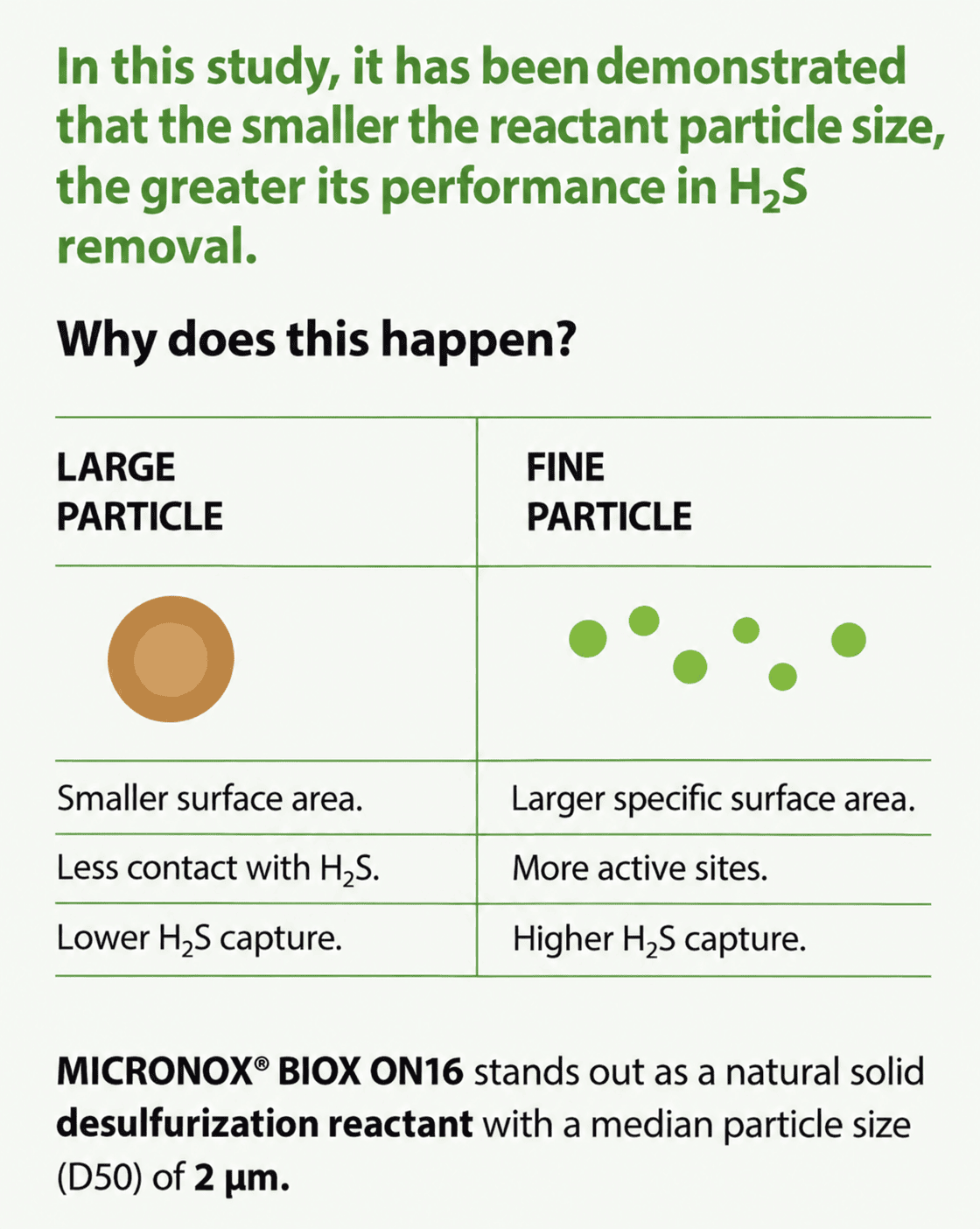
To specifically isolate the effect of particle size, two natural iron oxyhydroxides with identical composition but different mean particle sizes – 10 µm and 2 µm – were compared. Both were tested in parallel in 5-litre reactors for 144 days, under equivalent conditions and using the same dosing regime.
A significant reduction in H₂S
During the additive dosing phase, the reactor treated with the micronised 2 µm material showed an average H₂S concentration 19% lower than that recorded with the 10 µm product, with maximum differences of up to 33%.
The results are consistent with the hypothesis that a smaller particle size increases the available external surface area and promotes contact between the iron oxyhydroxide and sulphur species.
In other words, it is not only how much iron the product contains that matters, but also how much of that iron is accessible to react effectively with H₂S.
Without compromising process stability
Reducing the particle size produced no detectable negative effects on parameters such as pH, conductivity, ammoniacal nitrogen, chemical oxygen demand (COD) removal or volatile solids removal.
In addition, towards the end of the trial, the reactor treated with the finer material produced approximately 5% more biogas. During the additive dosing phase, the average methane content was 70.8% in R1 and 71.7% in R2, a small difference with no consistent trend.
A greater accumulation of volatile fatty acids (VFAs) was also observed in the reactor treated with the micronised product: a maximum of 2,308 mg/L compared with 1,127 mg/L in the reactor using the 10 µm material. However, this increase was not accompanied by any loss of overall process stability.
The study suggests that greater involvement of direct interspecies electron transfer (DIET) mechanisms could be a possible explanation, although this mechanism was not directly demonstrated during the trial.
Micronisation is more than simply grinding finer
The results reinforce a clear conclusion: the chemical composition of the product matters, but so does its particle size.
Under the conditions studied, reducing the mean particle size from 10 to 2 µm resulted in greater apparent H₂S retention efficiency, with no detectable negative effects on the main anaerobic digestion stability parameters.
For PROMINDSA, these results reinforce the importance we have placed, since the development of MICRONOX® ON16, on understanding our raw material, its processing and, in particular, controlling its particle size.
The full study is available to our customers upon request.